
More great reads: the best books for 11 year olds
"The world of genetic science opens up in this fascinating read"
January 2024 Non-Fiction Book of the Month
This is a perfect non-fiction book for budding scientists and all young people who are full of “why is my hair brown?” type questions and want intelligent, in-depth answers in reply. Bright, clear illustrations and clever use of layouts make this an enthralling read, whilst simple to follow explanations make even the heaviest of concepts and subjects easy to read about.
Starting with Gregor Mendel’s discovery of the fundamental principles of genetics in 19th century Austria, this is an exciting journey through the history of genetic science. Packed with interesting facts for young minds to soak up and revel in, such as how salmon sperm were integral to an early discovery of DNA.
From there we look at how cell mutations can occur, and how they can cause serious diseases and hereditary illnesses, such as cancer and sickle cell disease. But also, how cell mutation can be very positive and are actually responsible for evolution and the diversity of life. I was particularly interested by the section that considers the nature nurture debate, which questions whether personality and behaviour are determined by genetic or environmental factors.
The explanation of Bouchard’s study into separated identical twins study made a huge concept both interesting and understandable.
More recent developments such as genetic engineering, gene therapy, cloning and CRISPR are then considered – looking at the risks, potentials, setbacks and ethical questions involved in each. Finally, we look to the future, asking whether Jurassic Park could become reality through advances in genetic science. And how genetic science can influence the development of new vaccines and help to fight future pandemics.
There is much to recommend this book, but I particularly appreciated the fascinating way that centuries of scientific research are shown to be connected, with scientists continually building on and linking to the work conducted before them. The author makes these links both clear and exciting, allowing the reader to follow suit and feel they too are building on the knowledge they have gained earlier in the book.
The wealth of information is complimented by a selection of activities, such as a code table that enables readers to translate messenger RNA themselves. These place the reader firmly in the scientists’ shoes, putting theory into practice.
Wonderfully readable and packed with incredible information!

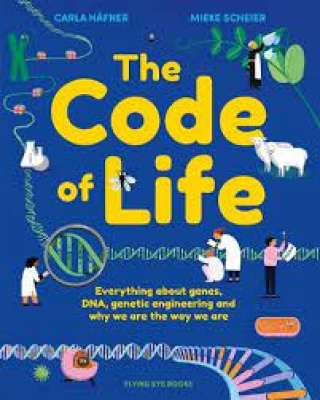
Why do children look like their parents? Why are some people blond and others brunette, and where do we get our eye colour from? This book explains genetic theory, what genes are, why DNA plays an important role and what all these insights have to do with a curious monk.
| Suitable For: | |
| Other Genres: | |
| Recommendations: |
Why do children look like their parents? Why are some people blond and others brunette, and where do we get our eye colour from?
The LoveReading4Kids Editorial Team have read and reviewed The Code of Life and determined it is suitable for children aged 11-14 years old
The Code of Life features in the following genres: Books of the Month, Recommendations, Featured Books for 13+ readers, Science, Children’s / Teenage: General interest, Children’s, Teenage and Educational, Featured Books for 11+ readers
Hardback. £13.49, down from the £14.99 cover price. In Stock.
The Code of Life was written by Dr. Carla Häfner and published by Flying Eye Books
The Code of Life has 68 pages
£13.49, reduced from £14.99. In Stock.