

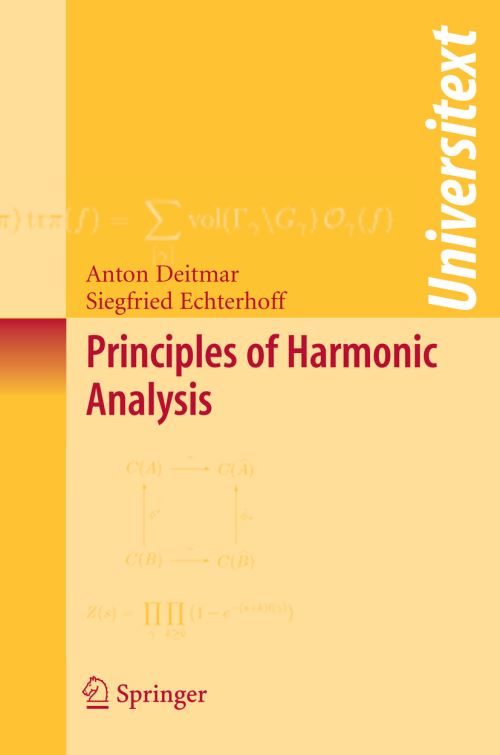
The tread of this book is formed by two fundamental principles of Harmonic Analysis: the Plancherel Formula and the Poisson S- mation Formula. We ?rst prove both for locally compact abelian groups. For non-abelian groups we discuss the Plancherel Theorem in the general situation for Type I groups.
The generalization of the Poisson Summation Formula to non-abelian groups is the S- berg Trace Formula, which we prove for arbitrary groups admitting uniform lattices. As examples for the application of the Trace F- mula we treat the Heisenberg group and the group SL (R). In the 2 2 former case the trace formula yields a decomposition of the L -space of the Heisenberg group modulo a lattice.
In the case SL (R), the 2 trace formula is used to derive results like the Weil asymptotic law for hyperbolic surfaces and to provide the analytic continuation of the Selberg zeta function. We ?nally include a chapter on the app- cations of abstract Harmonic Analysis on the theory of wavelets. The present book is a text book for a graduate course on abstract harmonic analysis and its applications.
The book can be used as a follow up of the First Course in Harmonic Analysis, [9], or indep- dently, if the students have required a modest knowledge of Fourier Analysis already. In this book, among other things, proofs are given of Pontryagin Duality and the Plancherel Theorem for LCA-groups, which were mentioned but not proved in [9].
| ISBN: | 9780387854687 |
| Publication date: | 21st November 2008 |
| Author: | Anton Deitmar, Siegfried Echterhoff |
| Publisher: | Springer an imprint of Springer New York |
| Format: | Paperback |
| Pagination: | 333 pages |
| Series: | Universitext |
The tread of this book is formed by two fundamental principles of Harmonic Analysis: the Plancherel Formula and the Poisson S- mation Formula. We ?rst prove both for locally compact abelian groups.
Hardback, Paperback. Not Available.
Principles of Harmonic Analysis was written by Anton Deitmar, Siegfried Echterhoff and published by Springer an imprint of Springer New York
Principles of Harmonic Analysis has 333 pages
Yes it is part of Universitext series