

This month, we are celebrating the endlessly inventive Brian Bilston - often dubbed the "Poet Laureate of Twitter”. Known for his sharp wit, satirical edge, and ingenious wordplay, Brian’s poetry is as clever as it is hilarious. He playfully blends humour and social commentary, often using inventive formats like spreadsheets, Venn diagrams, or flowcharts to bring his verses to life.
Many readers first encounter his work through social media, where a funny or incisive poem might pop up unexpectedly in their feed. In many ways, this modern method of sharing echoes the oral traditions of early poets when verses were passed from person to person long before the age of mass publishing.
After building a large and loyal following online, Brian published his first collection of poetry You Took the Last Bus Home in 2016. He has followed that with two further collections for adults, and his fiction debut Diary of a Somebody which was shortlisted for the Costa Book Award for First Novel. Brian has also published four poetry collections for children, with his fun collection of pet inspired poems Let Sleeping Cats Lie recently shortlisted for the CLiPPA poetry award.
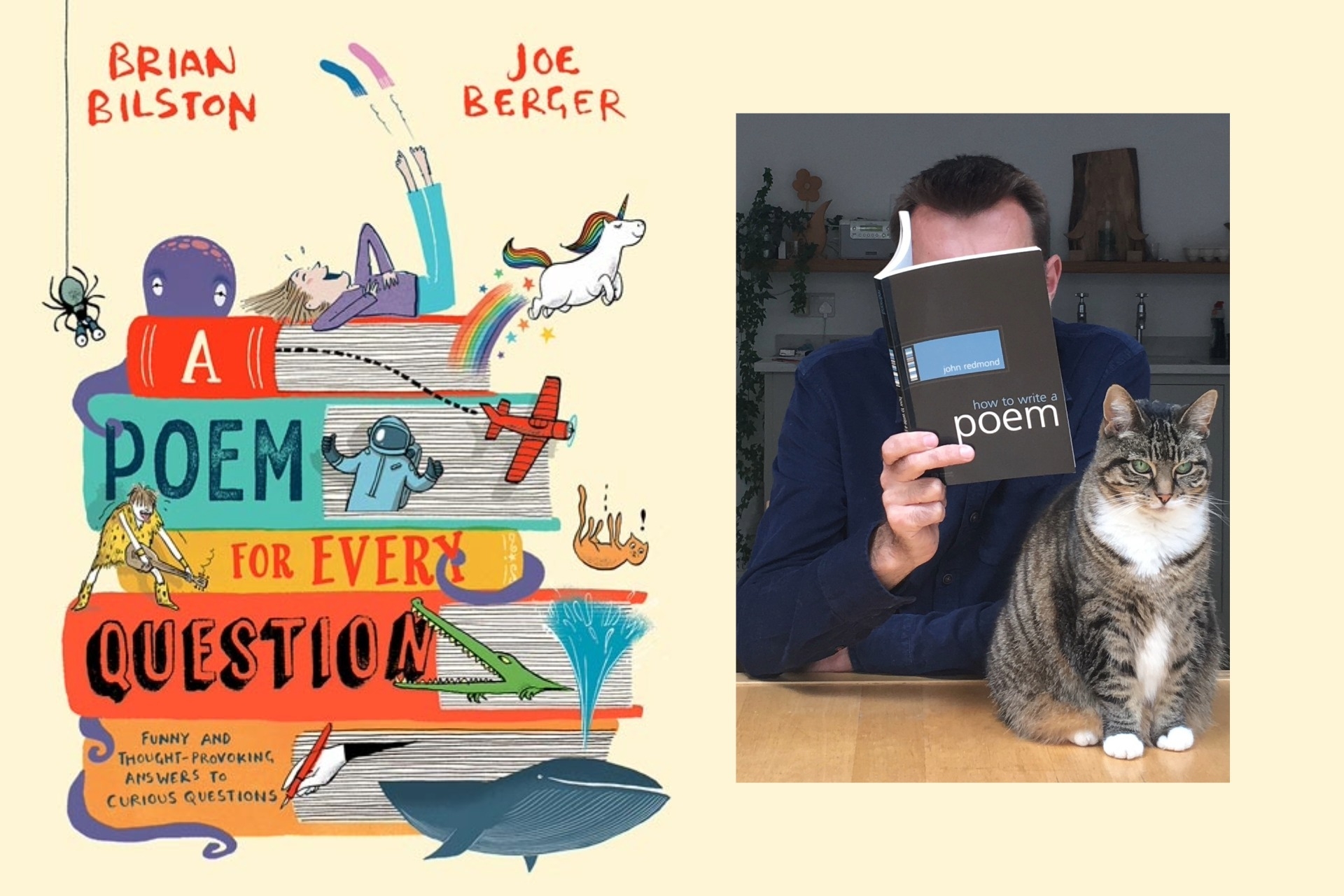
His latest collection A Poem for Every Question is a brillintly funny and thought-provoking mix of verse and facts as Brian attempts to answer a series of questions as diverse and useful as Are Bats the Only Flying Mammals?, How Long Can You Survive in a Desert if you Drink Your Own Pee?, What Does Gravity Do? and Which Country Has the Most Bicycles?. As our reviewer, Amy McKay said "This is a book that provides a strong opportunity to encourage fact hungry young readers to consider the wonders of poetry, or awaken poetry fans to the delights of non-fiction texts. Regardless of your preference for either, it will be a unique addition to any poetry or information book collection."
Q. Kids instinctively love poetry, from nursery rhymes for very young children up to the huge popularity in verse novels for young adults. How does the age of your audience alter your writing process?
A. Not hugely, if I’m honest. All those things which I enjoy when writing a poem – playing with words, for instance, or with form – I try to retain, whatever the age of the reader might be. I don’t believe in ‘dumbing down’ when writing for children, nor do I try to impress adult readers with overly complex language or construction. I think the main difference, for me, is in the subjects that I choose to write about; that’s usually the determining factor in who ends up reading my poetry.
Q. Your poems often blend humour with deeper social commentary. How do you strike that balance when writing your poetry?
A. It is a balancing act. I find it easier, though, to write about difficult subjects when I can inject some humour or irony into the poem – and I think that light amongst the darkness is important. Humour tends to be my default position; without it, if I attempt to write a poem about a serious subject, it doesn’t go particularly well for me. It’s all too earnest, the voice of the poem doesn’t sound like mine.
Q. You use a lot of clever devices in your poems, often they are visually structured in clever ways such as your use of the palindrome in Refugees, and the Venn diagram in At The Intersection. What draws you to these formats?
A. One of the original driving forces behind this came from ‘publishing’ these poems on social media. My poems were surrounded by lots of visual ‘content’ – videos, photos, cartoons etc – so sometimes I’d look for ways I could make my poems more visually interesting, too. But beyond that, I love puzzles and playing around with words, so it seemed like a natural step to apply that kind of thinking to the form and structure of my poems.
Q. Many of your poems reflect on the absurdities of modern life -technology, politics, bureaucracy. Why do you think poetry is a good medium for this kind of critique?
A. It’s more about writing what you know. I find much of modern life absurd; I’m not sure I could get through it if I took it all too seriously. There is so much of this world which is ridiculous or unfair or doesn’t make sense and that manifests itself at the macro global level but also in everyday life. Bin day, for instance, could probably serve as a larger metaphor about the mundanity and futility of existence, so what better topic for poetry to cover?
Q. You were famously anonymous for a time, and still are careful to hide your identity continuing to write under your pseudonym. How has that affected your writing and do you think the public enjoys the mystery?
A. I’m less shadowy these days now I have to go out and about and read poems to people in real life, but even then audiences are very good about not sharing photos. That makes me think they do enjoy the mystique of ‘Brian’. For me, it’s helpful because I can put a little distance (millimetres!) between me and my poetry. Being more naturally shy and underconfident, I think this makes me more likely to take risks in my poetry – both in terms of what I write about and then reading it in public.
Q. How do you know when a poem is finished?
A. I’m not entirely sure I do. I still fiddle with poems which were published in print seven or eight years ago. As Paul Valery is supposed to have said, ‘a poem is never finished, only abandoned’. I think I’ve got better at understanding what poems to properly abandon (ie to put in the bin) and then, with the poems that remain, how to get them as near finished as it might possibly be. Reading my work out loud is always a good test – is this a poem I might read on the stage, and if not, what can I do to fix it?
Q. You are often described as the Poet Laureate of Twitter, and have built up a huge following on social media. What makes you decide not to share something, and have you ever regretted posting a poem online?
A. I used to write purely for social media, but now a lot of what I write doesn’t end up on any platform. Usually, it’s a practical decision to do with length – poetry on social media works best when it’s short and snappy – and sometimes context or relevance. There have been many times I’ve regretted posting a poem online. The one that still gets to me was a poem called America is a Gun; it was something I’d written in response to a specific reaction on Twitter (to Jeb Bush posting a pic of a handgun with the caption ‘My America’). People on Twitter then began to post pictures of, for example, a cup of tea with the caption ‘My England’. I made a poem out of these responses. I’m hugely anti-firearms but, without this original context, the poem sets my teeth on edge. Annoying then, that it’s become one of my popular poems online. I’ve never put it into print.
Q. Did you enjoy reading poetry when you were younger, and do you have a favourite poet from your childhood to recommend to our readers?
A. I didn’t read much poetry when I was very young but as a teenager, I discovered the poems of John Hegley. I didn’t know poetry was allowed to be so funny – nor that it could be performed with such brilliance and comedy. In terms of younger readers, I’d really recommend a bit of Shel Silverstein, who I didn’t really encounter until I was much older. His poems are funny, too, but also full of kindness and quiet wisdom.
A. Is there a poem that you learnt by heart as a young child, and that you can still now recall? And do you think it is valuable for children to learn and recite poetry in this way?
A. I knew a lot of Spike Milligan’s shorter poems by heart:
There are holes in the sky
Where the rain gets in
But they’re ever so small
That’s why the rain is thin.
It’s lovely to be able to recall them still. But I don’t think children necessarily need to learn how to remember poems, but hopefully some will just stick in your head because they make you laugh or speak deeply to you in some way.
Q. Any tips you can share with aspiring young poets?
A. Read poetry! You’ll end up being a better poet for it. Think about what it is that you like about certain poems. Maybe these are things you could try in your own poetry, but in a way that is uniquely yours. Also, write for yourself, not for other people. Write about what’s in your heart – and let your own voice shine through. Finally, have fun with the language, with your thoughts, and your imagination. Or, in other words, enjoy it!
For more poetry-related content, check out our features and genres below:
Children's & Teenage Stories in Verse
70 Books Celebrating our Love of Poetry on National Poetry Day



Comments (0)
Leave A Reply
You must be logged in to post a comment.