

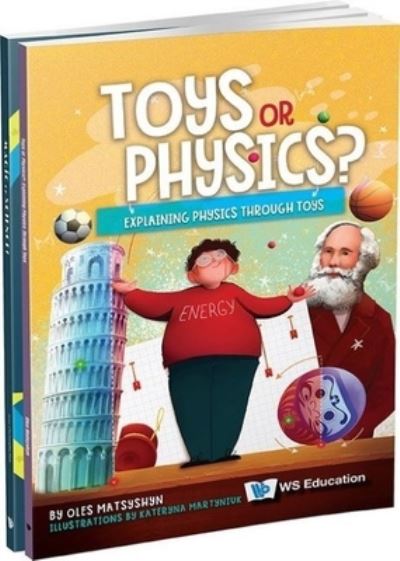
Magic or science? Toys or physics? Have you ever looked at an object or trick and wondered what the science behind it is?In Magic or Science?, Magicians pull off fantastic feats: Levitating a meter above the ground, charming a snake with a flute, finding lost objects with the help of a pendulum, swallowing a sword or walking on embers ...
But how do they do it? Is it magic or is it science? Learn to question and discover how science can explain most of the secrets surrounding these amazing wonders.Get ready to move to the other side of the mirror!Toys or Physics? will amaze young readers and spark their interest in physics.
With full-colour illustrations and simple-to-read explanations, Toys or Physics? examines well-loved toys and games, and breaks down essential physics concepts through fun and play.This book is for three groups of people: Curious young minds interested in learning about science through engaging images and experiential activities.;Families who want to spend more time together.;Everyone interested in the physics of everyday phenomena.
Some of the toys examined in this book might even challenge your understanding of how the universe operates!;This book was created with the help of the Max Planck Institute for the Physics of Complex Systems.What's inside:
| ISBN: | 9789811289675 |
| Publication date: | 17th October 2024 |
| Author: | JeanChristophe Piot, Oles Matsyshyn |
| Illustrator: | Zelda Zonk, Kateryna Martyniuk |
| Publisher: | World Scientific Publishing an imprint of WS EDUCATION (CHILDREN'S) |
| Format: | Paperback |
| Pagination: | 168 pages |
| Genres: |
Children’s: picture books, activity books, early learning concepts |
Magic or science? Toys or physics?
features in the following genres: Children’s: picture books, activity books, early learning concepts
Paperback. £11.25, down from the £12.50 cover price. Not Available.
was written by JeanChristophe Piot, Oles Matsyshyn and published by World Scientific Publishing an imprint of WS EDUCATION (CHILDREN'S)
has 168 pages
£11.25, reduced from £12.50. Not Available.