

Circle Yuen is an award-winning author and illustrator from Hong Kong, now based in the UK. A graduate of the MA in Children’s Book Illustration at Cambridge School of Art, her work explores universal themes of family, resilience and social justice. Through her expressive and sensitive illustrations, Circle captures a wide range of emotions, gently encouraging young readers to approach life’s challenges with calmness and thoughtfulness, while fostering empathy, compassion and an understanding of others.
Behind the Illustrations: In Conversation with Circle Yuen
 Q. How would you describe your own style of illustration?
A. This is probably the hardest question for me. If I have to put a name to it, I’d describe my illustration style as direct and emotional. I like to draw feelings rather than simply illustrate what is happening in the story. I often need to experience something with my body before I can draw it honestly.
Q. Do you have a preferred medium or materials you like to work with? What draws you to them?
A. I like working in mixed media, choosing different materials depending on what each story needs. I always carry a sketchbook about the size of my hand. I used to think the more materials, the better. Slowly, I realised that the cheaper they are, the more freely I experiment.
I gave up the lightbox early on. Once a rough is settled, I draw it straight onto the paper for the final illustration. It gives me the most direct connection with the image.
Q. Has your artistic style been influenced by any particular illustrator or illustrators? If so, how have they inspired or shaped your work?
A. Quentin Blake. During a pause in my studies, I went back to Hong Kong. On the top floor of the Hong Kong Central Library, I found a reference-only book in which he wrote about his drawings for NHS hospitals. I could only read it there, so I kept going back.
There was a drawing of a girl in her pyjamas at a window, sharing breadcrumbs with the birds on the sill. I couldn’t stop looking at it. It was made for an eating disorder unit, as part of a series called Ordinary Life. There are no words, and yet it says more than words could.
For people living through a storm, art can bring a little light. I think that is at the heart of my work.
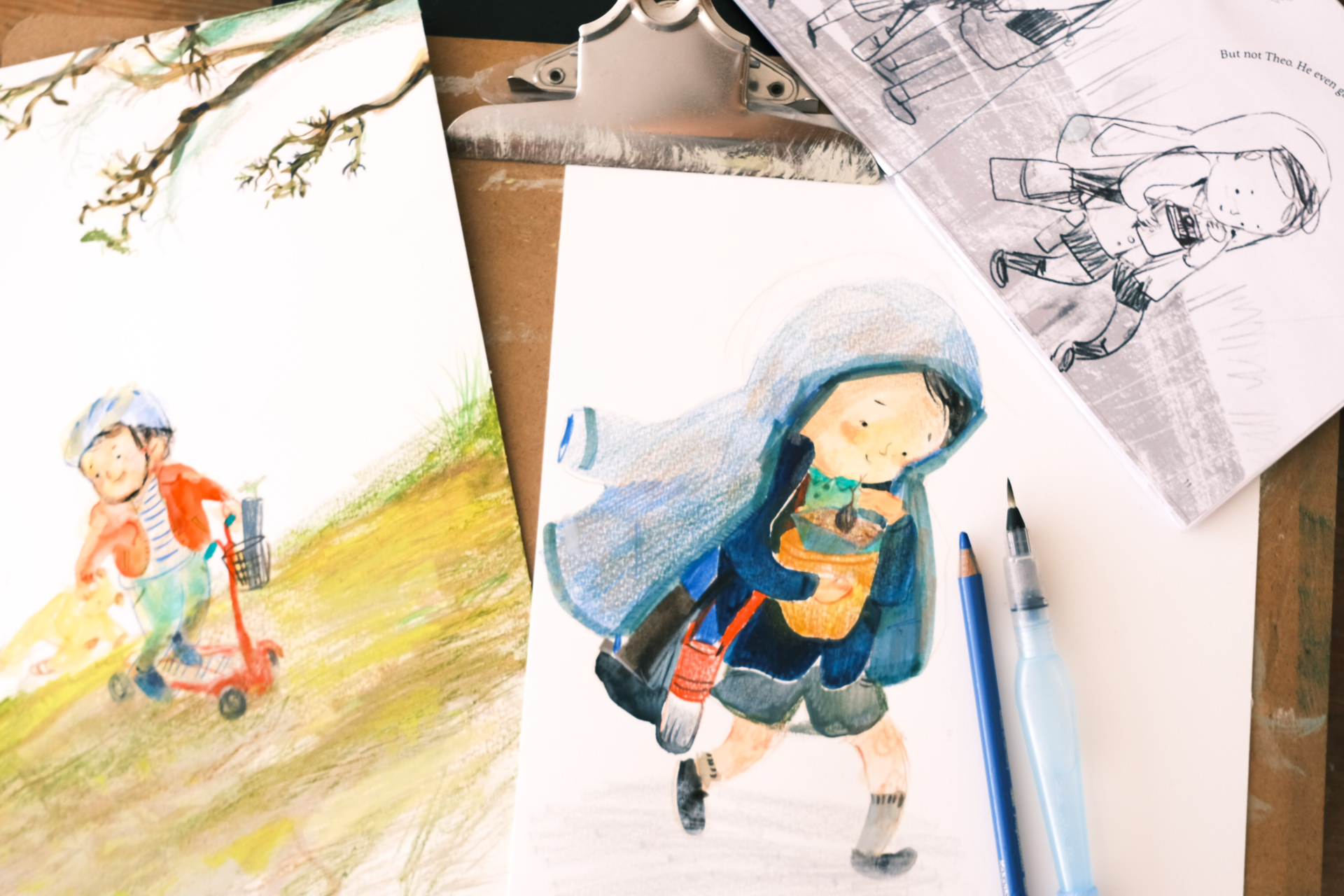
Q. In Oakie, Theo and Oakie have a very special relationship. How did you approach visually capturing the bond between a little boy and his tiny tree?
A. I thought a lot about Theo’s weight. The first time he holds Oakie, his whole body leans in, tight and careful. I wanted their bond to be felt through his body. Later, Theo tries to mend Oakie in his own way, and I drew him sticking on little plasters to hold the leaves back. I wanted to show his agency, rather than simply showing him feeling sad.
I kept thinking about Michael Pollan’s Second Nature: A Gardener’s Education, and the idea of a garden as something shaped by both the life of the plants and the gardener. The gardener may tend the garden, but the plants have their own life and rhythms too. That shaped the way I drew Theo and Oakie’s relationship.
Theo thinks he is looking after Oakie, but Oakie is also helping Theo grow. By looking after something he cannot completely control, Theo slowly finds a way to face change. By the end of the book, the way they hold each other has changed.

Q. Nature is such an important part of Oakie. What inspired your approach to illustrating the trees, plants and outdoor settings, and did you draw on any particular places or landscapes?
A. I grew up in Hong Kong, and I had never seen an oak tree before I came to the UK. When I saw grass turned white with frost for the first time, without thinking, I picked up a dry leaf. How could a leaf be so beautiful? Its wavy edges were rimmed with ice, and I didn’t even know its name.
Isla McGuckin’s text for Oakie is beautiful. When I read the final text, it felt like a map. I followed the words like a hike, and through drawing, I discovered scenery I had never seen.
I live in Nottingham. Under the big oak in Wollaton Park, I found an acorn and brought it home to my balcony. Nothing happened all winter. In March, just as I was about to give up, it came up. I drew its leaves on the balcony as their colour changed day by day. Like Theo, I began to get to know this place, and myself.

Q. Your picture books Oakie and Our Dance explore big feelings such as worry, attachment and fear of loss in a gentle way. How did you use your illustrations to help communicate these emotions?
A. I think worry and attachment are two sides of the same thing. Theo worries because he loves Oakie. In Our Dance, the girl misses her daddy because she loves him. I didn’t want the pictures to take those feelings away, only to give them somewhere to rest.
So I often work with what is left out. In Our Dance, I chose not to show the conflict. A falling cup and clothes hangers on the floor are enough. Children can feel what has happened without having to see it. In Oakie, when Theo is at his most worried, I cropped a Christmas tree across the page like a wall, to keep the focus on his inner world.
Time became another way of carrying emotion in Oakie. While working on the book, I heard a tree planter say, "We've been planting these trees for hundreds of years, not just ourselves... So we learn to think in tree time, and not our time."
I found something very moving in that. Theo wants to know what will happen to Oakie, but trees do not live by our sense of time. Sometimes loving something means looking after it without knowing what will happen next, and trusting that something may be growing even when we cannot see it yet.

Q. Where do you do most of your creative work? Do you have a studio or a favourite workspace that helps inspire your creativity?
A. I work from a home studio. The good thing about working at home is that I can steal time once my little daughter is asleep and get straight back to work. For a while, I didn’t have a space of my own, so I laid A3 sheets covered in mark-making and texture experiments on top of the tumble dryer and across the floor. That’s how the past few years have been, switching between housework and artwork.
I also love sketching at my local library while listening in on storytime. Little ones sit on their grannies’ laps, small hands holding big picture books, while others crawl between the bookshelves. I love guessing which books they’re hugging on their way home.

Q. What advice would you give to aspiring illustrators? How challenging is it to break into the world of children's book illustration today?
A. When I was 35, I signed up from Hong Kong for the first online summer course at Cambridge School of Art, launched during the pandemic. I didn’t even know how to use gouache. One day, I was drawing on location at a bus stop, and a stranger asked me, “Are you an artist?”
I was terrified. “No,” I said. “I’m just a student.”
You can be afraid, but start now. You don’t need to know the destination before you set off. Before you really have to choose, every step is simply an action. Sharing a drawing online is an action. Applying for one more competition is an action.
Don't be afraid to ask for help. Find programmes and people that can support you. A mentor matters more than you think.
It is challenging. After my MA, the rejections came steadily. The reason was almost always the same: too difficult, not enough market for it. Later, at a BookTrust Represent event, a speaker said, “Whoever you are, own it.” It brought me to tears. It reminded me how important it is to be honest in your work, and with yourself.
Keep believing that the story in your hands will find its readers.
Discover More of Circle Yuen’s Beautiful Books
A huge thank you to Circle Yuen for sharing such thoughtful and inspiring insights into her creative journey, the emotions behind her beautiful illustrations and her advice for aspiring artists. It's been a joy to discover more about the care, sensitivity and imagination she brings to her work, and the powerful messages of love, resilience and hope woven through her stories. To explore more of Circle's wonderful books, simply click on the book jackets below to read our expert reviews, buy a copy or download an extract.


Comments (0)
Leave A Reply
You must be logged in to post a comment.