


Sue Meikle is an Early Years Educator, with a specialism in language development and with over 25 years of experience. Throughout her career she has combined her love of storytelling with helping children grow their speech and language skills. We are delighted that Sue has written this exclusive feature for LoveReading4Kids on the power of storytelling, one of the pillars of the National Year of Reading.
Storytelling is one of the most significant features in language that we use for communication. We use storytelling skills in almost every conversation that we have.
We use storytelling to talk about what we did at the weekend or to explain a great TV show that we just watched on Netflix. We even use it to describe our dreams, because we even dream with a story line, whether it makes sense or not!
Storytelling language (also referred to as ‘narrative’ by speech and language therapists) typically focusses on the principles of who, where, when and what happened next?
In an educational setting, these elements are often re-worded to character, setting, problem and solution! Whatever structure they are presented in, storytelling is essential for young children’s language.
Beyond the book
The 2026 ‘National Year of Reading’ campaign is explicitly reinforcing that reading matters deeply in childhood. But the language we use in reading and for reading also goes beyond the book that we hold in our hands.
The language that children experience in books can be transferred to the act of storytelling and storytelling is something that each child can own, shape and transfer to their own experiences.
Storytelling develops confidence, creativity, imagination and shared connections.
So, what is storytelling language exactly?
Quite simply, it is the language used (in a story-like structure) in every day speech e.g.
“Yesterday I went to the park with my Grandad and we fed the ducks. Then, I had a sleep over at Grandad’s house and when it was the morning, my mummy picked me up in her blue car!”
Using this language a child is conveying meaning to a listener through expressive language.
We can also identify the storytelling (narrative) components here:
Who = Grandad, ducks, mummy
Where = The park, grandad’s house, home
When = Yesterday, then (or next), in the morning (all concepts of time)
What happened = Fed the ducks, had a sleep over, went in the car …
How do we know the impact of storytelling skills in children’s early years?
Over 25 years ago, myself and three other highly skilled early years specialists piloted a project in Stockport in Greater Manchester called the L.E.A.P. Project (Language Enrichment Approach Pilot).
This project ran for a number of years and we used a storytelling tool (written by speech therapists) to specifically teach ‘storytelling language’ in nursery classes and early years centres to children, who were identified as having delayed language skills, yet did not meet the criteria for a speech and language therapy referral.
By equipping these children with the concepts of who, where, when and what happened next, through structured games, play and stories, the children’s language skills increased on average by almost 40% in a really short time.
Why does having ‘good’ storytelling language matter?
Storytelling language IS expressive language. It’s the language that is required for communication, reading and writing.
With better language, children are more likely to be able to regulate their emotions.
With better language, children are able to develop socially and form quality friendships.
With better language, children are able to develop in their play (remembering that in early years, play is learning).
With better language, children have the tools to develop reading skills.
With better language, children have the tools to develop writing skills.
Here is a very simple and true example of what happens before and after a child has developed storytelling skills and the impact on the child’s expressive language.

A teacher showed a child this picture and said, “What is happening?”
Child responded:
(Before) Without storytelling language: “That doin’ that!”
(After) With storytelling language: “The goose is flapping its wings!”
(Credit to Judith Carey – Speech and Language Therapist, for this real-life anecdote)
How do books impact storytelling language in the early years?
Books (specifically picture books for children in their early years) are a special treasure. They have the power to help develop a child’s language and narrative skills effortlessly. Picture books contain ALL the ingredients that we are looking for, in one beautifully illustrated package.
Picture books are expertly crafted with young children and their development in mind.
Let’s take for example: We’re Going on a Bear Hunt by Michael Rosen and Helen Oxenbury.
The components of a good narrative (storytelling) are all there!
We’ve got the who’s: A dad, sisters, brother, a baby, a dog and a bear.
We’ve got the where’s: In a home, over grassy hills, through thick, oozy mud, stumbling through forests and tip-toeing into caves and so on.
We’ve got the when: On a beautiful day! (also, day/night/routine concepts)
And, SPOILER ALERT …
We’ve got the what happened: They find the bear that they were looking for and it chased them all the way home!
And this iconic story is a perfect example of the narrative learning that a child can be exposed to with a picture book.
A child in one of my group sessions had never seen a picture of a bear before. At the start of the session, I showed him the picture of the bear and asked, “Who is this?” He responded with a shrug of the shoulders, indicating, “I don’t know!”
We shared this story a number of times, over the course of 6 weeks. At the end of the half term, when I repeated the question, “Who is this?” his immediate (and confident and LOUD) response was, “It’s a bear!!!!!” and then he added, “It’s gonna’ chase them! Quick guys … run!”
The child was able to give this information because of the storytelling language that he had gained from the story, and because the magic of the picture book had brought those characters to life and sparked his imagination and excitement and therefore, he was keen to let everyone else know exactly what was going to happen!
And imagine how wonderful this is when children have the opportunity to transfer this story in to ‘play’ – all choosing to be different characters to go on a bear hunt, and who says it has to be the characters from the book, in imaginary play those characters can be whoever the children want them to be. I’ve seen spiderman go on a bear hunt before now … and why not!?
And this is just one story … The choice of quality picture books gives us a whole trove of treasure to share with children and their storytelling language will, without question be significantly better for it!
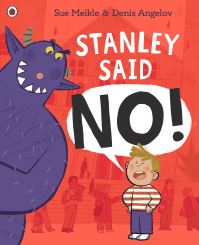
Sue Meikle's debut picture book, Stanley Said No! is available to buy now, published by Ladybird Books an imprint of Penguin Random House Children's UK. Read our full review by Andrea Reece, download an extract and add it to your shopping basket knowing that with every purchase on LoveReading4Kids a school close to your heart will benefit.

Comments (0)
Leave A Reply
You must be logged in to post a comment.