

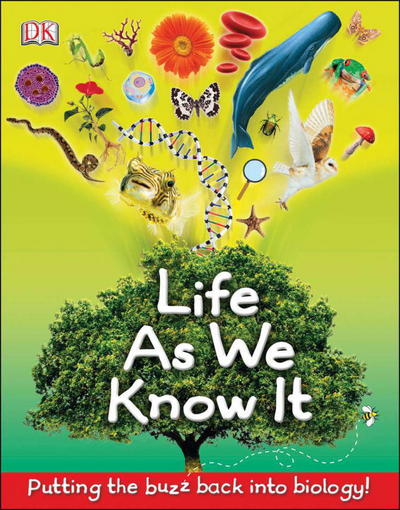
As far as we know, Earth is the only inhabited planet in the Universe. So what makes Earth such an ideal place for life to survive? And how did it all get started? Life as We Know It goes back to the beginnings of life on our planet, explaining to middle grade readers how it emerged under hostile conditions from a chemical soup as a simple self-contained unit: the cell. Key biological themes, such as how cells work, produce energy, and reproduce are explained in simple terms. This knowledge is then used to explain how more complex organisms live.
The book also looks at the wide variety of plant and animal life on Earth and how it evolved, and introduces the features and characteristics of members of the six kingdoms of life. Young readers will learn how life forms have adapted to occupy particular niches and what can happen if something upsets this balance.
Lavishly illustrated with images from DK's extensive natural history photo library, this encyclopedia is a visual feast as well as a thorough treatment of biology. Through DK's unique visual style, scientific ideas that might appear intimidating in a textbook are made lucid at a glance.
| ISBN: | 9780756691691 |
| Publication date: | 16th April 2012 |
| Author: | Robert M L Winston |
| Publisher: | Dorling Kindersley an imprint of DK |
| Format: | Hardback |
| Pagination: | 96 pages |
| Genres: |
Science |
As far as we know, Earth is the only inhabited planet in the Universe. So what makes Earth such an ideal place for life to survive?
Life as We Know It features in the following genres: Science
Hardback. Not Available.
Life as We Know It was written by Robert M L Winston and published by Dorling Kindersley an imprint of DK
Life as We Know It has 96 pages