

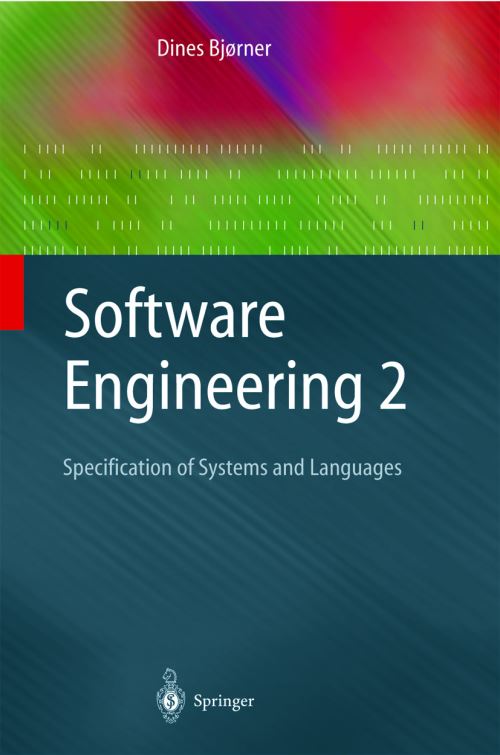
The art, craft, discipline, logic, practice and science of developing large-scale software products needs a professional base. The textbooks in this three-volume set combine informal, engineeringly sound approaches with the rigor of formal, mathematics-based approaches.
This volume covers the basic principles and techniques of specifying systems and languages. It deals with modelling the semiotics (pragmatics, semantics and syntax of systems and languages), modelling spatial and simple temporal phenomena, and such specialized topics as modularity (incl. UML class diagrams), Petri nets, live sequence charts, statecharts, and temporal logics, including the duration calculus.
Finally, the book presents techniques for interpreter and compiler development of functional, imperative, modular and parallel programming languages.
This book is targeted at late undergraduate to early graduate university students, and researchers of programming methodologies. Vol. 1of this series is a prerequisite text.
| ISBN: | 9783540211501 |
| Publication date: | 22nd February 2006 |
| Author: | D Bjørner, Christian Krog Madsen, European Association for Theoretical Computer Science |
| Publisher: | Springer an imprint of Springer Berlin Heidelberg |
| Format: | Hardback |
| Pagination: | 777 pages |
| Series: | Texts in Theoretical Computer Science : An EATCS Series |
The art, craft, discipline, logic, practice and science of developing large-scale software products needs a professional base. The textbooks in this three-volume set combine informal, engineeringly sound approaches with the rigor of formal, mathematics-based approaches.
Hardback. Not Available.
Software Engineering 2 was written by D Bjørner, Christian Krog Madsen, European Association for Theoretical Computer Science and published by Springer an imprint of Springer Berlin Heidelberg
Software Engineering 2 has 777 pages
Yes it is part of Texts in Theoretical Computer Science : An EATCS Series series