

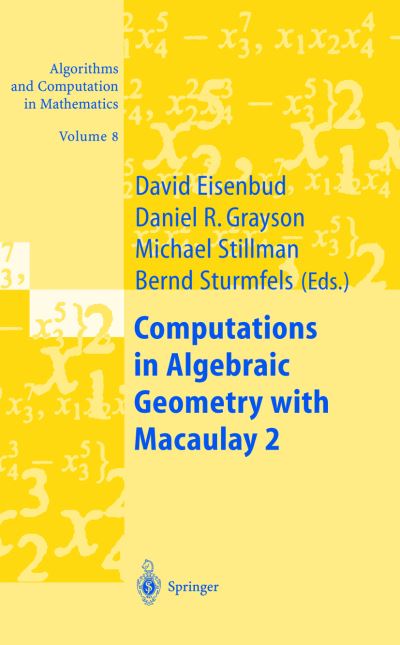
Systems of polynomial equations arise throughout mathematics, science, and engineering. Algebraic geometry provides powerful theoretical techniques for studying the qualitative and quantitative features of their solution sets. Re- cently developed algorithms have made theoretical aspects of the subject accessible to a broad range of mathematicians and scientists.
The algorith- mic approach to the subject has two principal aims: developing new tools for research within mathematics, and providing new tools for modeling and solv- ing problems that arise in the sciences and engineering. A healthy synergy emerges, as new theorems yield new algorithms and emerging applications lead to new theoretical questions. This book presents algorithmic tools for algebraic geometry and experi- mental applications of them.
It also introduces a software system in which the tools have been implemented and with which the experiments can be carried out. Macaulay 2 is a computer algebra system devoted to supporting research in algebraic geometry, commutative algebra, and their applications. The reader of this book will encounter Macaulay 2 in the context of concrete applications and practical computations in algebraic geometry.
The expositions of the algorithmic tools presented here are designed to serve as a useful guide for those wishing to bring such tools to bear on their own problems. A wide range of mathematical scientists should find these expositions valuable. This includes both the users of other programs similar to Macaulay 2 (for example, Singular and CoCoA) and those who are not interested in explicit machine computations at all.
| ISBN: | 9783540422303 |
| Publication date: | 25th September 2001 |
| Author: | David Eisenbud, Daniel R Grayson, Mike Stillman, Bernd Sturmfels |
| Publisher: | Springer an imprint of Springer Berlin Heidelberg |
| Format: | Hardback |
| Pagination: | 329 pages |
| Series: | Algorithms and Computation in Mathematics |
Systems of polynomial equations arise throughout mathematics, science, and engineering. Algebraic geometry provides powerful theoretical techniques for studying the qualitative and quantitative features of their solution sets.
Hardback. Not Available.
Computations in Algebraic Geometry With Macaulay 2 was written by David Eisenbud, Daniel R Grayson, Mike Stillman, Bernd Sturmfels and published by Springer an imprint of Springer Berlin Heidelberg
Computations in Algebraic Geometry With Macaulay 2 has 329 pages
Yes it is part of Algorithms and Computation in Mathematics series