

In a way, the world is made up of approximations, and surely there is no exception in the world of statistics. In fact, approximations, especially large sample approximations, are very important parts of both theoretical and - plied statistics.TheGaussiandistribution,alsoknownasthe normaldistri- tion,is merelyonesuchexample,dueto thewell-knowncentrallimittheorem. Large-sample techniques provide solutions to many practical problems; they simplify our solutions to di?cult, sometimes intractable problems; they j- tify our solutions; and they guide us to directions of improvements.
On the other hand, just because large-sample approximations are used everywhere, and every day, it does not guarantee that they are used properly, and, when the techniques are misused, there may be serious consequences. 2 Example 1 (Asymptotic? distribution). Likelihood ratio test (LRT) is one of the fundamental techniques in statistics.
It is well known that, in the 2 "standard" situation, the asymptotic null distribution of the LRT is?,with the degreesoffreedomequaltothe di?erencebetweenthedimensions,de?ned as the numbers of free parameters, of the two nested models being compared (e.g., Rice 1995, pp. 310).
This might lead to a wrong impression that the 2 asymptotic (null) distribution of the LRT is always? . A similar mistake 2 might take place when dealing with Pearson's? -test-the asymptotic distri- 2 2 bution of Pearson's? -test is not always? (e.g., Moore 1978).
| ISBN: | 9781461426233 |
| Publication date: | 5th September 2012 |
| Author: | Jiming Jiang |
| Publisher: | Springer an imprint of Springer New York |
| Format: | Paperback |
| Pagination: | 610 pages |
| Series: | Springer Texts in Statistics |
In a way, the world is made up of approximations, and surely there is no exception in the world of statistics. In fact, approximations, especially large sample approximations, are very important parts of both theoretical and - plied statistics.TheGaussiandistribution,alsoknownasthe normaldistri- tion,is merelyonesuchexample,dueto thewell-knowncentrallimittheorem.
Paperback. Not Available.
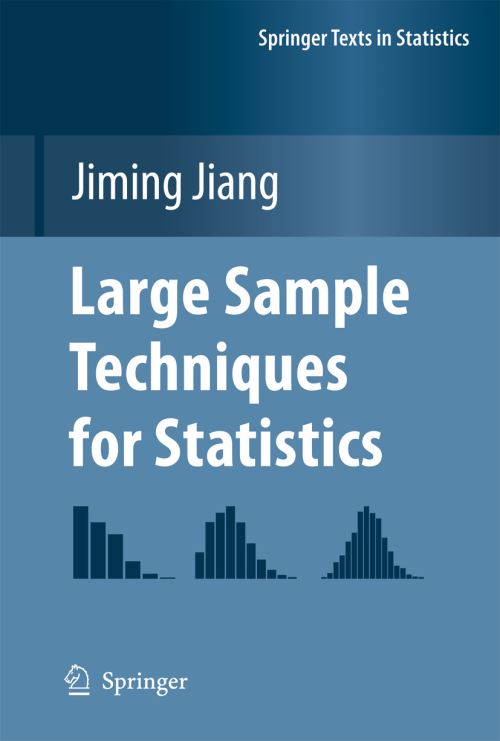
Large Sample Techniques for Statistics was written by Jiming Jiang and published by Springer an imprint of Springer New York
Large Sample Techniques for Statistics has 610 pages
Yes it is part of Springer Texts in Statistics series