

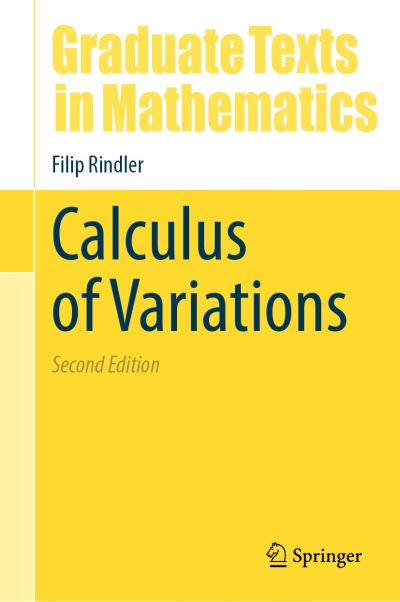
This book offers advanced undergraduates, graduate students, and researchers a comprehensive introduction to both the classical and modern Calculus of Variations. It can serve as the main text for a lecture course, the foundation for a reading seminar, or as a companion for independent study. This thoroughly revised second edition features numerous improvements, including the addition of several new topics, an enhanced order of presentation, and expanded references to the literature.
Starting with a string of motivating examples, the first half of the book presents the central elements of the classical theory, including the Direct Method, the Euler-Lagrange equation, Lagrange multipliers, Noether's theorem, and some regularity theory. Using the efficient framework of Young measures, the text then develops the vectorial theory of integral functionals, covering quasiconvexity, polyconvexity, relaxation, and ?-convergence. The second half of the book introduces more recent developments, some of which have previously been accessible only in the research literature. Topics treated in detail include rigidity for differential inclusions, microstructure, convex integration, concentrations in measures, linear growth functionals on functions of bounded variation (BV), and generalized Young measures.
The reader is expected to be familiar with vector analysis, functional analysis, basic measure theory, and some Sobolev space theory; essential preliminaries are reviewed in an appendix.
| ISBN: | 9783032244826 |
| Publication date: | 22nd May 2026 |
| Author: | Filip Rindler |
| Publisher: | Springer an imprint of Springer Nature Switzerland |
| Format: | Hardback |
| Pagination: | 459 pages |
| Series: | Graduate Texts in Mathematics |
This book offers advanced undergraduates, graduate students, and researchers a comprehensive introduction to both the classical and modern Calculus of Variations. It can serve as the main text for a lecture course, the foundation for a reading seminar, or as a companion for independent study.
Hardback. £40.49, down from the £44.99 cover price. Not Available.
Calculus of Variations was written by Filip Rindler and published by Springer an imprint of Springer Nature Switzerland
Calculus of Variations has 459 pages
Yes it is part of Graduate Texts in Mathematics series
£40.49, reduced from £44.99. Not Available.