

10% off all books and free delivery over £40
Buy from our bookstore and 25% of the cover price will be given to a school of your choice to buy more books. *15% of eBooks.

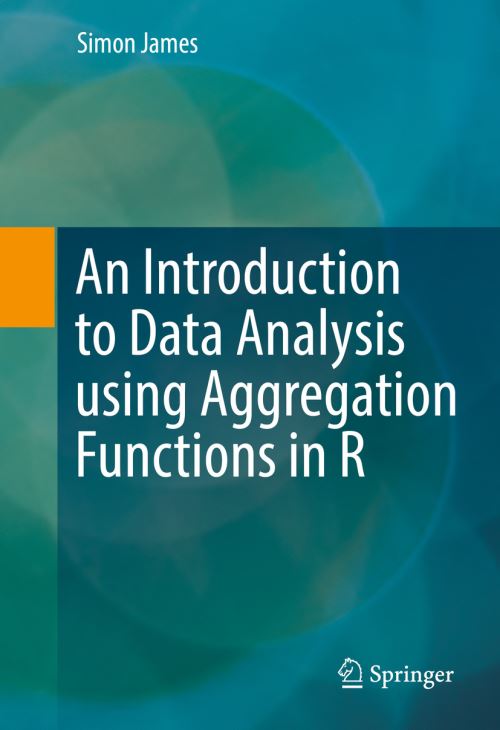
An Introduction to Data Analysis Using Aggregation Functions in R

View All Editions (1)

The selected edition of this book is not available to buy right now.
Add To Wishlist
Write A Review

About

An Introduction to Data Analysis Using Aggregation Functions in R Synopsis

This textbook helps future data analysts comprehend aggregation function theory and methods in an accessible way, focusing on a fundamental understanding of the data and summarization tools. Offering a broad overview of recent trends in aggregation research, it complements any study in statistical or machine learning techniques. Readers will learn how to program key functions in R without obtaining an extensive programming background.

Sections of the textbook cover background information and context, aggregating data with averaging functions, power means, and weighted averages including the Borda count. It explains how to transform data using normalization or scaling and standardization, as well as log, polynomial, and rank transforms. The section on averaging with interaction introduces OWS functions and the Choquet integral, simple functions that allow the handling of non-independent inputs. The final chapters examine software analysis with an emphasison parameter identification rather than technical aspects.

This textbook is designed for students studying computer science or business who are interested in tools for summarizing and interpreting data, without requiring a strong mathematical background. It is also suitable for those working on sophisticated data science techniques who seek a better conception of fundamental data aggregation. Solutions to the practice questions are included in the textbook.

About This Edition

ISBN: 9783319467610
Publication date:
Author: Simon James
Publisher: Springer an imprint of Springer International Publishing
Format: Hardback
Pagination: 199 pages

Frequently asked questions