

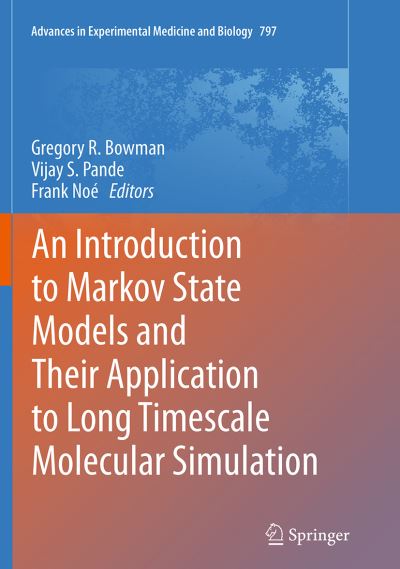
The aim of this book volume is to explain the importance of Markov state models to molecular simulation, how they work, and how they can be applied to a range of problems.
The Markov state model (MSM) approach aims to address two key challenges of molecular simulation:
1) How to reach long timescales using short simulations of detailed molecular models.
2) How to systematically gain insight from the resulting sea of data.
MSMs do this by providing a compact representation of the vast conformational space available to biomolecules by decomposing it into states sets of rapidly interconverting conformations and the rates of transitioning between states. This kinetic definition allows one to easily vary the temporal and spatial resolution of an MSM from high-resolution models capable of quantitative agreement with (or prediction of) experiment to low-resolution models that facilitate understanding. Additionally, MSMs facilitate the calculation of quantities that are difficult to obtain from more direct MD analyses, such as the ensemble of transition pathways.
This book introduces the mathematical foundations of Markov models, how they can be used to analyze simulations and drive efficient simulations, and some of the insights these models have yielded in a variety of applications of molecular simulation.
| ISBN: | 9789402407624 |
| Publication date: | 18th September 2016 |
| Author: | Gregory R Bowman, Vijay S Pande, Frank Noé |
| Publisher: | Springer an imprint of Springer Netherlands |
| Format: | Paperback |
| Pagination: | 139 pages |
| Series: | Advances in Experimental Medicine and Biology |
The aim of this book volume is to explain the importance of Markov state models to molecular simulation, how they work, and how they can be applied to a range of problems.The Markov state model (MSM) approach aims to address two key challenges of molecular simulation:1) How to reach long timescales using short simulations of detailed molecular models.2) How to systematically gain insight from the resulting sea of data.MSMs do this by providing a compact representation of the vast conformational space available to biomolecules by decomposing it into states sets of rapidly interconverting conformations and the rates of transitioning between states. This kinetic definition allows one to easily vary the temporal and spatial resolution of an MSM from high-resolution models capable of quantitative agreement with (or prediction of) experiment to low-resolution models that facilitate understanding. Additionally, MSMs facilitate the calculation of quantities that are difficult to obtain from more direct MD analyses, such as the ensemble of transition pathways.This book introduces the mathematical foundations of Markov models, how they can be used to analyze simulations and drive efficient simulations, and some of the insights these models have yielded in a variety of applications of molecular simulation.
Paperback. Not Available.
An Introduction to Markov State Models and Their Application to Long Timescale Molecular Simulation was written by Gregory R Bowman, Vijay S Pande, Frank Noé and published by Springer an imprint of Springer Netherlands
An Introduction to Markov State Models and Their Application to Long Timescale Molecular Simulation has 139 pages
Yes it is part of Advances in Experimental Medicine and Biology series