

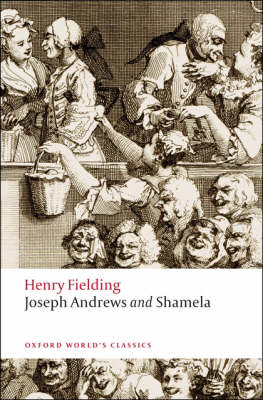
'I beg as soon as you get Fielding's Joseph Andrews, I fear in Ridicule of your Pamela and of Virtue in the Notion of Don Quixote's Manner, you would send it to me by the very first Coach.' (George Cheyne in a letter to Samuel Richardson, February 1742) Both Joseph Andrews (1742) and Shamela (1741) were prompted by the success of Richardson's Pamela (1740), of which Shamela is a splendidly bawdy parody. But in Shamela Fielding also demonstrates his concern for the corruption of contemporary society, politics, religion, morality, and taste. The same themes - together with a presentation of love as charity, as friendship, and in its sexual taste - are present in Joseph Andrews, Fielding's first novel.
It is a work of considerable literary sophistication and satirical verve, but its appeal lies also in its spirit of comic affirmation, epitomized in the celebrated character of Parson Adams. This revised and expanded edition follows the text of Joseph Andrews established by Martin C. Battestin for the definitive Wesleyan Edition of Fielding's works.The text of Shamela is based on the first edition, and two substantial appendices reprint the preliminary matter from Conyers Middleton's Life of Cicero and the second edition of Richardson's Pamela (both closely parodied in Shamela).
A new introduction by Thomas Keymer situates Fielding's works in their critical and historical contexts.
'I beg as soon as you get Fielding's Joseph Andrews, I fear in Ridicule of your Pamela and of Virtue in the Notion of Don Quixote's Manner, you would send it to me by the very first Coach.' (George Cheyne in a letter to Samuel Richardson, February 1742) Both Joseph Andrews (1742) and Shamela (1741) were prompted by the success of Richardson's Pamela (1740), of which Shamela is a splendidly bawdy parody. But in Shamela Fielding also demonstrates his concern for the corruption of contemporary society, politics, religion, morality, and taste. The same themes - together with a presentation of love as charity, as friendship, and in its sexual taste - are present in Joseph Andrews, Fielding's first novel.
| Suitable For: | |
| Recommendations: |
'I beg as soon as you get Fielding's Joseph Andrews, I fear in Ridicule of your Pamela and of Virtue in the Notion of Don Quixote's Manner, you would send it to me by the very first Coach.' (George Cheyne in a letter to Samuel Richardson, February 1742) Both Joseph Andrews (1742) and Shamela (1741) were prompted by the success of Richardson's Pamela (1740), of which Shamela is a splendidly bawdy parody. But in Shamela Fielding also demonstrates his concern for the corruption of contemporary society, politics, religion, morality, and taste.
The LoveReading4Kids Editorial Team have read and reviewed Joseph Andrews And Shamela and determined it is suitable for children aged 13-14 years old
Joseph Andrews And Shamela features in the following genres: Recommended Children's eBooks, Recommendations, Featured Books for 13+ readers
Paperback. £8.09, down from the £8.99 cover price. In Stock.
Joseph Andrews And Shamela was written by Henry Fielding and published by Oxford University Press
Joseph Andrews And Shamela has 464 pages
Yes it is part of Oxford World's Classics series
£8.09, reduced from £8.99. In Stock.